
Ask most business owners or businesses how they decide who gets sent on a training course, and you’ll usually get a shrug. It could be:-
- Someone mentioned a course
- A manager had a hunch
- Budget was left over at year-end and needed spending before it disappeared
It’s not that anyone’s being lazy — it’s just that, without something better to go on, training decisions default to guesswork.
That’s the problem a skill framework quietly solves.
What we’re talking about
A skill framework is nothing more exotic than a clear map of what skills your business needs, and how good someone needs to be at each one. Not vague statements like “good communicator” or “team player” — proper, specific definitions: what does “good” look like for a sales advisor handling a complaint, versus a team leader coaching a new starter through the same situation?
Once you’ve defined that, you can compare it against what your people can do today. And that gap — between where someone is and where the role needs them to be — is where training should be aimed. Every time.
The bit everyone underestimates.
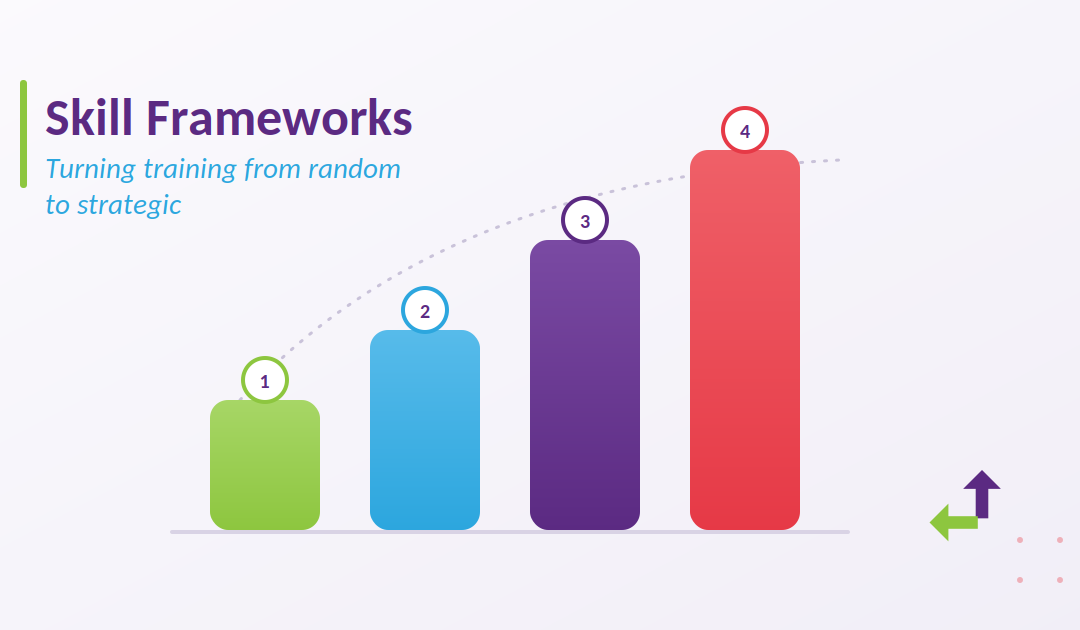
Here’s the sentence worth pinning above your desk: skill frameworks define required skills and ability levels, and in doing so, they transform training from random to strategic.
That word “random” isn’t an exaggeration. Most training budgets in the UK still get spent reactively — a complaint comes in, so everyone gets a customer service refresher; a new system launches, so there’s a scramble to book generic IT training. It feels productive. It rarely moves the needle, because it’s solving for the loudest problem, not the real one.
A framework flips that around. Instead of asking “what training’s going spare?”, you start asking “what does this role actually require, and where exactly are we falling short?” Training stops being something you throw at people and starts being something you aim.
Why it matters in 2026!
Skill frameworks aren’t new. What’s changed is the pace everything else is moving at.
- Roles are shifting faster than job descriptions can keep up. AI tools, new compliance rules, and changing customer expectations mean the skills a role needed in 2023 aren’t necessarily the ones it needs now. Without a framework, nobody notices the gap until it’s already caused a problem.
- Budgets are tighter, and every pound of training spend must justify itself. Finance teams are asking harder questions about ROI. “We don’t really know why we booked that course” isn’t an answer that survives scrutiny anymore.
- People want to see a path, not just a payslip. Retention is harder than it’s ever been, and one of the biggest reasons people leave is that they can’t see how to grow. A framework gives you something concrete to show them: here’s what the next level looks like, here’s exactly what’s missing.
What it looks like in practice
You don’t need a 40-page competency matrix to get started. A workable framework for a small or mid-sized business might just be:
- A list of the roles in your business.
- For each role, the five or six skills that genuinely make the difference between doing it adequately and doing it well.
- A simple scale (even 1–4) describing what each level of that skill looks like in behaviour, not jargon.
- A quick, honest look at where your current team sits against that scale.
That’s it. It’s not glamorous. But it turns “we should probably do some training” into “Sarah needs to move from a 2 to a 3 in objection handling, and here’s the specific course or coaching that gets her there.”
The knock-on effect
Once training has a target, everything downstream gets easier. Appraisals stop being vague chats about “how’s it going” and become conversations grounded in actual skill gaps. Recruitment gets sharper, because you’re hiring against defined ability levels rather than a gut feeling about someone’s CV; and when someone asks, “what did that training budget actually achieve this year?”, you’ve got a genuine answer.
None of this requires a huge system or a consultancy contract. It requires sitting down, being honest about what your roles genuinely need, and writing it down properly for the first time.
Training was never meant to be random. In 2026, with budgets tighter and roles changing faster than ever, businesses that keep training on autopilot are the ones that’ll fall behind — quietly, then all at once. A skill framework is how you make sure that doesn’t happen to yours.
Feel free to download our FREE skills framework sheet to help you get on top of your businesses or departments training or coaching needs. Take look at our sessions to see if we can help.